
Dari Magnet ke Soket: Bagaimana Elektrik Sampai ke RumahFrom Magnet to Wall Socket: How Electricity Reaches Your Home
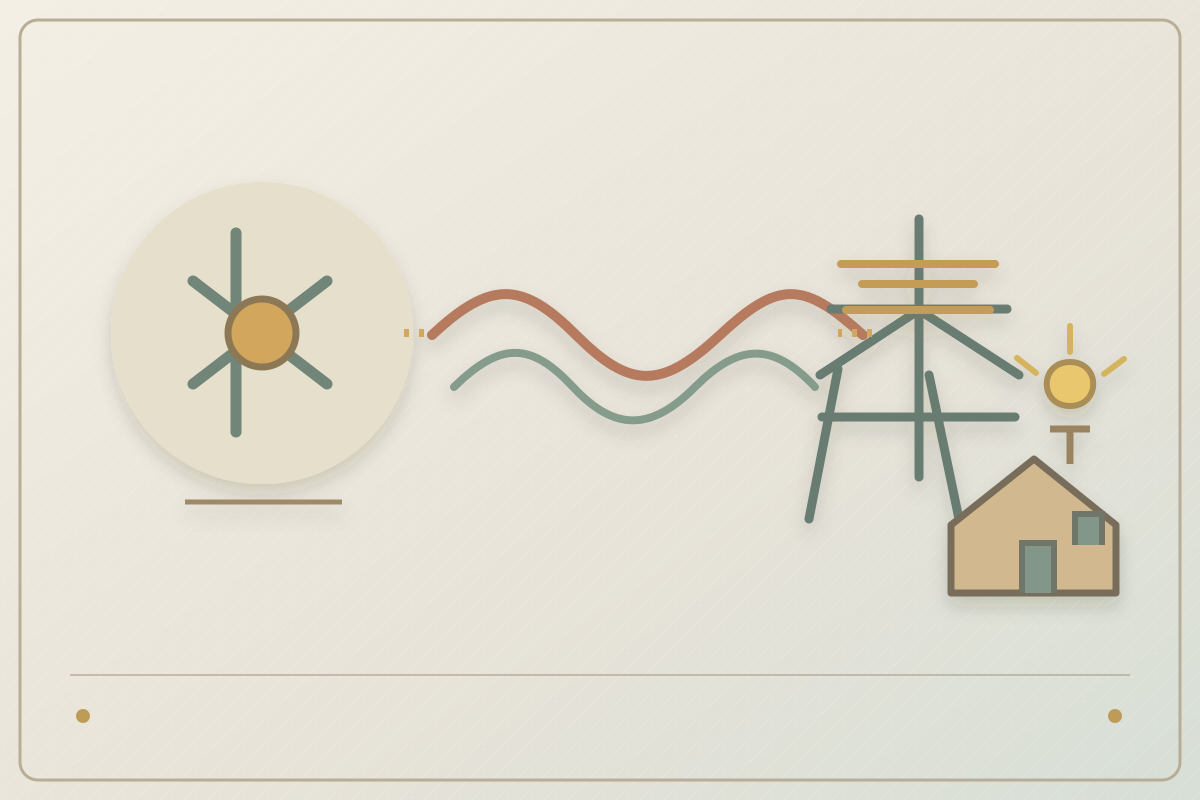
Elektrik tidak muncul kerana manusia mencipta cas daripada kosong. Cas dan kilat sudah wujud di alam semula jadi; manusia belajar memahami, menghasilkan dan mengalirkan tenaga elektrik dengan cara yang boleh digunakan. Kisah soket di dinding bermula jauh sebelum lampu rumah menyala.
DARIPADA PETIR KEPADA GENERATOR
Pada abad ke-18, eksperimen Benjamin Franklin membantu menunjukkan kaitan antara kilat dan elektrik. Bateri Volta pada 1800 menyediakan arus yang boleh digunakan secara berterusan untuk eksperimen. Namun, langkah besar untuk menghasilkan elektrik dalam jumlah banyak datang apabila Michael Faraday menunjukkan pada 1831 bahawa gerakan magnet relatif terhadap gegelung wayar boleh menghasilkan arus. Prinsip ini dipanggil aruhan elektromagnet.
Generator moden menggunakan idea yang sama. Air, angin, wap atau enjin memutarkan turbin dan bahagian generator. Magnet dan gegelung bergerak relatif antara satu sama lain, lalu tenaga gerakan ditukar menjadi tenaga elektrik. Panel solar melakukan perkara berbeza: sel fotovoltaik menukar cahaya matahari terus kepada elektrik tanpa memutar turbin.
PERJALANAN ELEKTRIK KE RUMAH
Alirannya boleh dibayangkan begini:
Sumber tenaga → generator atau panel solar → transformer menaikkan voltan → talian penghantaran jarak jauh → pencawang menurunkan voltan → rangkaian pengagihan setempat → meter dan papan suis rumah → soket dan peralatan.
Voltan dinaikkan untuk penghantaran supaya tenaga boleh bergerak jauh dengan kehilangan yang lebih rendah. Apabila sampai dekat bandar atau kawasan perumahan, pencawang menurunkannya ke tahap yang sesuai untuk rangkaian pengagihan. Transformer pada rangkaian dan sambungan rumah membantu memastikan bekalan sampai pada tahap yang boleh digunakan dengan selamat.
APA MAKSUD VOLTAN, ARUS DAN BIL ELEKTRIK?
Bayangkan voltan seperti tekanan yang mendorong cas bergerak, sementara arus ialah kadar aliran cas. Peralatan menukar tenaga elektrik kepada bentuk lain: lampu menjadi cahaya dan haba, kipas menjadi gerakan, peti sejuk memindahkan haba keluar dari ruangnya. Meter mengira tenaga yang digunakan, lazimnya dalam kilowatt-jam (kWh); itulah asas jumlah penggunaan pada bil.
Elektrik dalam grid bukan air yang disimpan di dalam paip menunggu untuk keluar. Bekalan perlu dijana dan diseimbangkan dengan penggunaan sepanjang masa. Bila ramai orang menghidupkan penyaman udara, sistem perlu membekalkan lebih banyak kuasa. Sebab itulah generator, kabel, transformer dan pencawang bekerja sebagai satu rangkaian.
Ringkasnya: alam menyediakan fenomena elektrik; manusia menemui cara menukarkan gerakan, cahaya dan sumber lain menjadi bekalan yang boleh dihantar. Apabila kita menekan suis, tenaga itu menempuh rangkaian yang panjang sebelum menghidupkan lampu.
Rujukan: U.S. EIA, Michael Faraday: https://www.eia.gov/kids/history-of-energy/famous-people/faraday.php
U.S. Department of Energy, Electricity Grid Backgrounder: https://www.energy.gov/sites/default/files/2023-11/FINAL_CESER%20Electricity%20Grid%20Backgrounder_508.pdf
U.S. National Park Service, The Origins of Hydroelectric Power: https://www.nps.gov/articles/5-the-origins-of-hydroelectric-power.htm
Electricity did not appear because people created electric charge from nothing. Charge and lightning already exist in nature; people learned how to understand, generate, and move electrical energy in useful ways. The story of a wall socket began long before the first home light came on.
FROM LIGHTNING TO GENERATORS
In the 18th century, Benjamin Franklin’s experiments helped show the connection between lightning and electricity. Volta’s battery in 1800 provided a steady current for experiments. A major step toward producing electricity in useful quantities came when Michael Faraday showed in 1831 that moving a magnet relative to a coil of wire could produce current. The principle is called electromagnetic induction.
Modern generators use the same idea. Water, wind, steam, or an engine turns a turbine and part of a generator. A magnet and coil move relative to each other, converting motion into electrical energy. Solar panels work differently: photovoltaic cells convert sunlight directly into electricity without turning a turbine.
THE JOURNEY TO YOUR HOME
The path can be pictured like this:
Energy source → generator or solar panel → transformer raises voltage → long-distance transmission lines → substation lowers voltage → local distribution network → home meter and switchboard → outlets and appliances.
Voltage is raised for transmission so energy can travel long distances with lower losses. Near towns and neighbourhoods, substations lower it for the distribution network. Transformers on the network and at service connections help deliver electricity at levels suitable for safe use.
WHAT DO VOLTAGE, CURRENT, AND YOUR BILL MEAN?
Think of voltage as the pressure that pushes charge to move, while current is the rate of charge flow. Appliances turn electrical energy into other forms: a lamp makes light and heat, a fan makes motion, and a refrigerator moves heat out of its interior. Your meter measures the energy used, usually in kilowatt-hours (kWh); that is the basis of the usage shown on your bill.
Grid electricity is not water stored in a pipe, waiting to come out. Supply has to be generated and balanced with demand continuously. When many people turn on air conditioners, the system needs to provide more power. Generators, cables, transformers, and substations therefore work as one network.
In short: nature provides electrical phenomena; people learned to turn motion, light, and other sources into a supply that can be delivered. When you press a switch, that energy has travelled through a long network before lighting the room.
References: U.S. EIA, Michael Faraday: https://www.eia.gov/kids/history-of-energy/famous-people/faraday.php
U.S. Department of Energy, Electricity Grid Backgrounder: https://www.energy.gov/sites/default/files/2023-11/FINAL_CESER%20Electricity%20Grid%20Backgrounder_508.pdf
U.S. National Park Service, The Origins of Hydroelectric Power: https://www.nps.gov/articles/5-the-origins-of-hydroelectric-power.htm
RUANG BUALTHE CONVERSATION
Apa yang kau fikir?What do you think? (0)
Jadi yang pertama mulakan perbualan.Start the conversation.